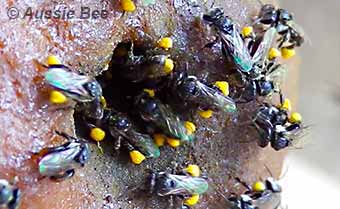
HOW TO CARE FOR YOUR NEST OF AUSTRALIAN STINGLESS BEES
Aussie Bee > How to Keep Australian Stingless Bees
How to rescue a damaged nest of Stingless Bees.
A nest or box of Australian Stingless Bees makes a wonderful addition to your backyard - whether you are a gardener, a small-crop grower or simply a lover of Australian wildlife.
-- They will help to pollinate your treasured plants.
-- They may supply you with a taste of their unique honey.
-- They have interesting social behaviour like the commercial honey bees, but they are stingless and easier to handle.
-- Best of all, they are "true blue" Australian bees.
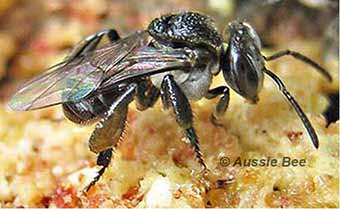
A 4mm long Tetragonula carbonaria Stingless Bee worker.
Your observations of their behaviour could help unravel some of the remaining mysteries of their secret lives within the nest.
Note: Stingless Bees are tropical species that only occur in the warmer parts of Australia:
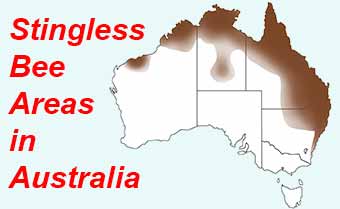
The Tetragonula species are mostly coastal while the Austroplebeia species can extend into inland areas.
Keeping Stingless Bees in their Original Log
The safest way to keep a nest of Stingless Bees is to leave it in its natural log. Even in experienced hands, some nests can die from the disruption of being transferred to a box.
A solid natural log can provide far better insulation for a nest than a wooden hive box can do. So a nest in its original log is a good choice if your climate is marginal for Stingless Bees e.g. on the South Coast of NSW. A natural log with a nest of Stingless Bees can also make a very attractive garden feature.
If you find a nest of Stingless Bees in a recently-fallen tree, it is important to check that it is well sealed up against ants and Honeybees! Read more about how to rescue nests of Stingless Bees.
Keeping Stingless Bees in a Boxed Hive
In many parts of Australia, Stingless Bees can also be successfully kept in boxed hives. However, as hive boxes offer less insulation than a log, special attention must be paid to the siting of the box - see below.
The boxes used for Stingless Bees are smaller than those used for commercial Honeybees (Apis mellifera). They also have a special two-part design that allows the nest to be propagated by a method called splitting. The photo below shows a Stingless Bee hive box designed by Russell Zabel.
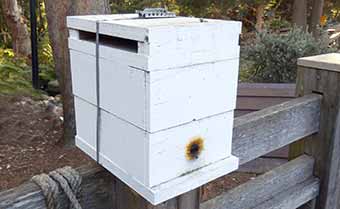
A hive for Australian Stingless Bees.
Small amounts of honey can be harvested from boxed hives of Stingless Bees in warm parts of Australia such as Queensland. (Remember that in colder areas such as Sydney, Stingless Bees may need all their supplies of honey to survive their dormant period in the winter.) Boxes with a separate compartment for the honey stores, making honey harvesting quicker and safer, can be purchased from some bee breeders, such as Tim Heard.
Full details about the designs of boxes for Australian Stingless Bees and step by step instructions for boxing and splitting hives can be found in the Stingless Bee publications available on this website.
Where to Site your Nest or Box of Stingless Bees
The nest or box should be sited in a warm spot in the garden, preferably with morning sun. The site should also be sheltered from extreme afternoon heat and from cold winds. The bees require flowers for pollen and nectar preferably within about 100 metres of the nest. They will happily use a wide variety of native and introduced flowers. In hot areas, a supply of water near the nest is also desirable.
Also remember that household and garden insecticides can kill bees. Take great care not to let your nest's foraging bees come in contact with insecticides.
Flies and Beetles that may Attack Stingless Bees
A weak or damaged nest or boxed hive may be attacked by some specific predators: tiny black Phorid flies, larger Syrphid flies which look like wasps with forked antennae, and South African Small Hive Beetles. These all love to lay their eggs on the honey and pollen stores. However, only a weak nest would allow the grubs to multiply to damaging levels. Again it is important to help the bees seal up any gaps in their nest defences as quickly as possible.
For one system of keeping out Small Hive Beetles, read Aussie Bee Online article 18.
Fighting Swarms
Sometimes a big swarm may form outside a nest or hive of Stingless Bees and large numbers of bees may begin wrestling with one another on the ground. This is called a Fighting Swarm. It is usually caused by worker bees from one colony attempting to take over another colony. While it looks alarming, Fighting Swarms do not usually cause the death of a colony and it may even end up stronger afterwards.
For more information on Fighting Swarms, read Aussie Bee Online article 13.
Want to know more?
For more practical information and tips on how to keep Stingless Bees, read the following eBooks from the Native Bees of Australia series:
-- Nests of Australian Stingless Bees
-- Behaviour of Australian Stingless Bees
-- How to Recognise the Different Types of Australian Stingless Bees
-- Keeping Australian Stingless Bees in a Log or Box
-- Boxing and Splitting Hives: A Complete Do it Yourself Guide for Stingless Bee Keepers
For full details on the above native bee eBooks, visit the Aussie Bee Shop.
We also recommend the excellent book published by Dr Tim Heard: The Australian Native Bee Book.
-- Top ten questions about Australian Stingless Bees.
-- How to buy a nest or box of Stingless Bees.
-- Stingless Bee honey.
-- Crop pollination with Stingless Bees.
-- Stingless Bee hive designs.