AUSTRALIAN BLUE BANDED BEES (AMEGILLA) FOR GREENHOUSE CROP POLLINATION
Aussie Bee > Bumblebee Problem > Blue Banded Bee Alternative Pollinator Option > Final Report 2012
Other Aussie Bee reports on the Bumble Bee problem:
-- Debate on using exotic bumblebees in Australia
-- How to identify a feral bumblebee
-- Have you seen a bumblebee on the Australian mainland?
-- What harm could feral bumblebees cause?
-- How far could feral bumblebees spread in Australia
-- Bumblebees and invasive weeds in Australia
Research Report 2012
See Also::
Research Update 2006
Research Update 2008
Dr Katja Hogendoorn of the University of Adelaide worked for six years on developing native blue banded bees for greenhouse tomato pollination.
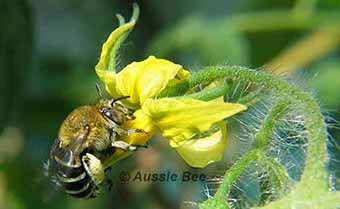
A native Australian Blue Banded Bee, Amegilla, Buzz Pollinating a tomato flower inside a greenhouse
Her goal was that our growers would be able to pollinate their crops with blue banded bees; instead of manually pollinating their crops or importing European bumblebees into Australia.
Katja made substantial progress towards her goal:
-- Blue banded bees are solitary native bees that normally only breed and fly in the summer months. However, Katja developed methods of making blue banded bees breed and fly all year round.
-- The nests of blue banded bees are prone to a fungus called chalkbrood that is lethal to the developing larvae. However, Katja developed hygienic techniques that kept chalkbrood outbreaks under control.
-- Katja demonstrated that blue banded bees are as efficient as European bumblebees in pollinating tomatoes. Furthermore tomatoes pollinated by bees taste better than manually pollinated tomatoes. A full account of this research can be seen in the following scientific paper:
K. Hogendoorn, F Bartholomaeus and MA Keller (2010) Chemical and Sensory Comparison of Tomatoes Pollinated by Bees and by a Pollination Wand. Journal of Economic Entomology 103(4): 1286-1292.
Katja's development of these blue banded bees for crop pollination ran into some practical obstacles that have yet to be overcome. For instance:
-- Importantly, greenhouse designs used in Australia would need to be changed to suit blue banded bees. Most designs have vents that allow the bees to escape. Others have screens that close on hot days and bees become trapped above these screens.
-- As the bees do not take pollen from a dish, the populations need to be maintained over summer in commercial greenhouses. This means that insecticide use would need to be changed, to allow the blue banded bees to breed.
-- Furthermore, to supply the industry in winter requires a large breeding area.
Project Funding
Katja's work was funded by the Australian Research Council. In addition Katja received some financial support in 2004 - 2006 from three large greenhouse tomato growers (P'petual, Flavorite and International Hydroponics), and from Timbercorp and marketing organisation Perfection Fresh in 2007 - 2009. Furthermore, Biological Services provided significant and invaluable support (both financial and practical) to the project throughout its course.
Future Directions
Unfortunately funding for the project ceased at the end of 2009 and, due to the obstacles mentioned, it has not led to commercial implementation. This seems disappointing, but it has to be remembered that the research needed to make these solitary bees work inside a greenhouse covers a large range of issues. The development of the breeding program for bumblebees in Europe took twenty years and involved multiple research groups. In contrast, Katja's work on the blue banded bees was only funded for six years and she was only assisted by a single half-time technician.
An application by horticulturalists to import European bumblebees into Australia for greenhouse tomato pollination was rejected by the Australian Government in 2008. The Environment Minister said these exotic bees "could have posed a serious risk to the Australian environment, native bee populations and native bird species."
So greenhouse tomato growers will have to continue to pollinate their tomatoes manually using vibrating wand tools.
Katja says the full development of a management program for native blue banded bees for greenhouse crop pollination would take time and commitment. If the horticultural industry wishes to reactivate this blue banded bee research, it would require the full support (both financial and practical endorsement) from the entire fresh tomato industry. Katja's specific recommendations are:
-- The fresh tomato industry should become a levy paying industry. This would allow them to fund and endorse research and development that is valuable to the industry as a whole, and to give any research project the critical mass it needs.
-- The industry also needs to weigh up the costs and benefits of bee-proofing their greenhouses. There would be initial investment costs for this and increased maintenance costs. The greenhouses would also need to be cooled during summer. Growers need to assess whether, from a business point of view, investment in alternative pollinators in the greenhouse is feasible and worthwhile.
-- If the enterprise seems worthwhile from a financial point of view, then development of blue banded bees as greenhouse pollinators is a possibility and requires a concerted effort by the industry.
FURTHER READING
Katja Hogendoorn, Zeta Steen and Michael P Schwarz (2000) Native Australian carpenter bees as a potential alternative to introducing bumble bees for tomato pollination in greenhouses. Journal of Apicultural Research 39: 67-74.
Katja Hogendoorn, Caroline L Gross, Margaret Sedgley and Michael A Keller (2006) increased tomato yield through pollination by native Australian Amegilla chlorocyanea (Hymenoptera: Anthophoridae). Journal of Economic Entomology 99(3): 828-833
Katja Hogendoorn, Steven Coventry and Michael A Keller (2007) Foraging behaviour of a blue banded bee, Amegilla chlorocyanea in greenhouses: implications for use as tomato pollinators. Apidologie 38: 86-92
Katja Hogendoorn, Faerlie Bartholomaeus and Michael A Keller (2010) Chemical and sensory comparison of tomatoes pollinated by bees and by a pollination wand. Journal of Economic Entomology 103(4): 1286-1292.
Other Aussie Bee reports on the Bumble Bee problem:
-- Debate on using exotic bumblebees in Australia
-- How to identify a feral bumblebee
-- Have you seen a bumblebee on the Australian mainland?
-- What harm could feral bumblebees cause?
-- How far could feral bumblebees spread in Australia
-- Bumblebees and invasive weeds in Australia